Friday, 20 April 2018

Is There A Space War Coming, And Are We Ready For It?


Space
 
Is There A Space War Coming, And Are We Ready For It?
 
According to the Outer Space Treaty, signed in 1967, space can only be used for peaceful purposes, and it doesn’t fall under the jurisdiction of any country.
 
 
Magog
 
Russia And Israel, Seven Decades On
 
Amid all the diplomatic maneuverings in the months that led up to the creation of the State of Israel 70 years ago, none are more curious than those undertaken by the Soviet Union.
 

Pathway To The Mark Of The Beast? A Cashless Society Is Slowly Gaining All Around The World!!

Cashless
 
Pathway To The Mark? Cashless Society Slowly Gaining Around The World
 
As electronic payment apps, debit cards and credit cards replace paper currency, governments, banks and corporations delight in the level of control this allows them over the population.
 

70
 
Israel: 70 Years Of Miracles
 
A century ago, even after the Balfour Declaration gave the Zionist movement its first real triumph, the notion of a Jewish state in what was then called Palestine was still considered a fantasy.
 

THE HEAVILY BIASED NATURE OF THE HAMAS "PRESS OFFICE" - A REPORT BY BASSAM TAWIL FROM "THE GATESTONE INSTITUTE"!!

Hamas "Press Office": Truth Finishes Last

by Bassam Tawil  •  April 20th 
  • Finally, the Hamas "Press Office" instructed Palestinian journalists to focus on the "humanization" of the stories of the Palestinians who are killed or injured during the mass demonstrations. Translation: If the "victim" is a Hamas terrorist, the journalists are to avoid mentioning that and instead report about his having been a beloved husband, father and community member.
  • Aren't Fatah and Abbas receiving financial aid from the US and EU because of their presumed support for a peace process with Israel? Why should the Americans and Europeans be supporting a Palestinian faction whose journalists openly incite against their Israeli colleagues?
Pictured: Palestinians in Gaza attempt to break through a section of the border fence with Israel, under cover of a smokescreen, March 30, 2018. (Image source: Ateya Bahar video screenshot).
Three weeks after the beginning of the mass demonstrations along the border between the Gaza Strip and Israel, which are being held as part of the so-called "March of Return," Hamas is trying to intimidate journalists into covering the events in a way that distorts the truth and reality.
Hamas, one of several Palestinian groups responsible for the anti-Israel demonstrations, does not want the world to see pictures of Palestinians throwing stones, firebombs and explosive devices at Israeli soldiers.
Hamas does not want journalists to use the words "clashes" and "confrontations" when reporting about the demonstrations.
Hamas does not want journalists to report the fact that some of the demonstrators killed during the "March of Return" were actually members of its armed group, Izaddin Al-Qassam.

Six More Countries Considering Embassy Move to Jerusalem, But How Safe Is Israel As They Celebrate Their 70th Birthday??

Netanyahu: World Leaders Seek Israel’s ‘Ingenuity and Genius’
WATCH: How Israelis Celebrate the Jewish State’s 70th Birthday!
Netanyahu Says 6 More Countries Considering Embassy Move to Jerusalem
How Secure is Israel at 70?Read Now

Being A "Good Man" Will Get You Into Heaven According To The Vatican As Pope Francis Comforts A Grieving Boy By Telling Him His Atheist Father Is ‘Surely In Heaven’ Because He Was A ‘Good Man’!!

New post on Now The End Begins

Pope Francis Comforts Grieving Boy By Telling Him His Atheist Father Is ‘Surely In Heaven’ Because He Was A ‘Good Man’

by Geoffrey Grider

pope-francis-tells-young-boy-atheist-father-is-in-heaven-because-good-man-catholic-church-vatican-lies

Watch as the Pope comforts a grieving boy who feared his atheist father isn't in heaven - and tells him that God is 'surely proud' of his dad, and that God wouldn't leave a 'good man' out of Heaven'

"For by grace are ye saved through faith; and that not of yourselves: it is the gift of God: Not of works, lest any man should boast." Ephesians 2:8,9 (KJV)
EDITOR'S NOTE: Over the years we've brought you stories about some of the spiritually horrific acts committed by various popes, past and present, not limited to and including Pope Francis warning people against have a 'personal relationship' with Jesus Christ. But this story, in my opinion, is far and away the worst one because not only did the pope lie about the very clear Bible teaching on salvation, he also gave this young boy and all the others presents a false hope on how people get to Heaven. Unsaved people do not and cannot go to Heaven because Heaven is only for believers redeemed by the shed blood of Jesus Christ. People do not go to Heaven because they are 'good', and they don't go to Hell because they were 'bad'. Heaven is for saved people and Hell is for the unsaved. That's what the Bible teaches. It is for reasons exactly like this that we continue to believe and teach that the Roman Catholic Church is not only not the church that Jesus started, it is not even Christian by any Biblical standard.
"But without faith it is impossible to please him: for he that cometh to God must believe that he is, and that he is a rewarder of them that diligently seek him." Hebrews 11:6 (KJV)
This is the touching moment Pope Francis comforted a grieving boy who was worried his father didn't go to heaven as he was an atheist. The boy, known only as Emanuele, broke down in tears as he approached the microphone to take part in a Q&A session with the pontiff who visited the St. Paul of the Cross parish on the outskirts of Rome on Sunday.
According to The National Catholic Reporter, Pope Francis told the crowd that Emanuele's father, who had recently passed away, was a 'good man' but hadn't believed in God.
And he reassured the heartbroken boy that his late father was in heaven because God is 'surely proud of him'.  The touching moment took place when Emanuele broke down while crying. Unable to get his words out, the Pope beckoned him to come forward and whisper the question and they pair had a private chat and shared a hug.

With Emanuele's permission, the Pope told the crowd that the boy had shown 'courage' to cry in front of everyone.

'If that man was able to make his children like that, then it's true, he was a good man.
"That man did not have the gift of faith, he wasn't a believer, but he had his children baptized. He had a good heart," Francis said.
He explained that God makes the decision on who is welcomed into heaven and said that he has 'a dad's heart'.
Describing Emanuele's father, he said: 'Do you think God would be able to leave him far from himself? Does God abandon his children when they are good?
The children in the crowd shouted back: 'No.' 'There, Emanuele, that is the answer,' the pope told Emanuele. 'God surely was proud of your father.' source

Saturday, 14 April 2018

IT BEGINS: President Trump Launches Cruise Missile Attack On Syria Backed Up By Both Britain And France!!

New post on Now The End Begins

IT BEGINS: President Trump Launches Cruise Missile Attack On Syria Back Up By Both England And France

by Geoffrey Grider

united-states-launches-missile-attack-syria-trump

President Trump ordered a military attack against Syrian President Bashar al-Assad on Friday, joining allies Britain and France in launching missile strikes in retaliation for what Western nations said was the deliberate gassing of Syrian civilians.

EDITOR'S NOTE: As we have been telling you all week, the United States was planning to launch a military strike against the Assad regime in Syria. Tonight that attack, aided by both France and the UK, was carried with stunning efficiency. So far there has been no response from Russia who has vowed repeatedly to meet any attack with equal force. We will be following this breaking story as it develops. 
The coordinated strike marked the second time in a year that Trump has used force against Assad, who U.S. officials believe has continued to test the West’s willingness to accept gruesome chemical attacks.
Trump announced the strikes in an address to the nation Friday evening.
The assault followed repeated threats of military action from Trump, who has been moved by civilian suffering to set aside his concerns about foreign military conflicts, since the reported chemical attack that killed civilians in the rebel-held town outside Damascus last weekend.
The operation capped nearly a week of debate in which Pentagon leaders voiced concerns that an attack could pull the United States into Syria’s civil war and trigger a dangerous conflict with Assad ally Russia — without necessarily halting chemical attacks.
Both Syria and Russia have denied involvement in the attack, which Russian Foreign Minister Sergei Lavrov alleged had been staged.
The episode is the latest illustration of the hazards arising from a conflict that has killed an estimated half-million people and drawn in world powers since it began as a peaceful uprising in 2011.
The attack raised the possibility of retaliation by Russia or Iran, which also provides military support to Assad, threatening in particular to increase the risks facing a force of 2,000 Americans in Syria, as part of the battle against the Islamic State. While the United States has not been at war with the Syrian government, U.S. troops often operate in proximity to those from Iranian- or Russian-backed groups.
In the wake of last weekend’s gruesome attack, some U.S. officials advocated a larger, and therefore riskier, strike than the limited action Trump had ordered in April 2017, also in response to suspected chemical weapons use.
That attack involved 59 Tomahawk missiles fired from two U.S. warships in the Mediterranean Sea. It fulfilled Trump’s vow that chemical weapons are a “red line” that he, unlike his predecessor Barack Obama, would not allow Assad to cross. But the airfield targeted by the Pentagon resumed operations shortly after the attack and, according to Western intelligence assessments, chemical attacks resumed.
Assad’s defiance has presented Trump with a choice of whether to make a larger statement and incur a larger risk this time. Planning for these strikes focused on ways to curb Assad’s ability to use such weapons again.
Risks of a wider attack include the possibility of a dangerous escalation with Russia, whose decision to send its military to Syria in 2015 reversed the course of the war in Assad’s favor. Since then, Russia has used Syria as a testing ground for some of its most sophisticated weaponry.
“Get ready Russia, because they will be coming, nice and new and ‘smart!’ ” Trump tweeted Wednesday, referring to U.S. missiles.
That took miliary officials by surprise. But on Thursday, Trump said he did not mean to suggest missile strikes were imminent.
“Never said when an attack on Syria would take place,” he tweeted. “Could be very soon or not so soon at all!”
A larger strike, possibly including stealth aircraft and strikes on multiple sites, could inflict lasting damage to military facilities and economic infrastructure that have been vital to Assad’s ability to gain the upper hand in a seven-year civil war.
Since last year’s strike, multiple chemical attacks have been reported in opposition areas, most of them involving chlorine rather than the nerve agent sarin, as was used in 2017, suggesting the government may have adjusted its tactics.
Among the chief factors military planners must consider are air defenses in Syria, which were bolstered by Russia’s decision to enter the war in 2015 and could pose a threat should the Pentagon employ manned aircraft in the attack. Their reach was demonstrated in February when an Israeli F-16 fighter jet crashedamid Syrian antiaircraft fire.
The United States has flown an array of aircraft over Syria since it began strikes against the Islamic State in 2014, but those operations have mostly steered clear of government and Russian activities. The Assad regime has not authorized the U.S. operations, but it also has not tried to shoot down American aircraft. source

10,000 Palestinians Gather On Israel Border With Kite Bombs And IEDs As Protest Continues For Second Week!!

New post on Now The End Begins

10,000 Palestinians Gather On Israel Border With Kite Bombs And IEDs As Protest Continues For Second Week

by Geoffrey Grider

palestinians-protest-gaza-border-kite-bomb-burning-tires-israel

Palestinians tried to fly a Molotov cocktail attached to a kite over the border between Gaza and Israel as more than 10,000 protested along the fence for a third straight Friday.

EDITOR'S NOTE: The Palestinians have no intention of giving up on their violent protests against Israel,  no matter how many people have to die in the process. For a second week straight, over 10,000 Palestinians, under the direction of terror group Hamas, did their best to incite and provoke the IDF to shoot at them. But ironically, most of the bombs they hurled at Israel actually failed to reach thier target and blew up Palestinians instead. 
The daring plot did not go as planned as the kite was instead blown into Gaza before it crashed to the ground and exploded. Another bomb was detonated near the Karni crossing, and may have caused Palestinian casualties.
Other demonstrators burned large Israeli flags and torched tyres while soldiers fired tear gas and live bullets at them from across the border fence as large plumes of smoke filled the sky.  Gaza health officials said 363 people were wounded by Israeli fire or treated for tear gas inhalation, but did not provide a breakdown.
Among those hurt was a Gaza journalist who was shot in the abdomen, the officials said, making him at least the second reporter to be shot during the protests since March 30.
The Israeli military said demonstrators hurled an explosive device and several fire bombs near the fence in what it said was an apparent attempt to damage. Others tried to cut through the fence to either flee inside Israel or raid security infrastructure before returning.
Footage distributed by the military showed an area of the fence made up of several layers of barbed wire coils. Protesters stuck a Palestinian flag into the fence and affixed a rope, using it to tug at the coils.
One man threw a burning tire into the fence, while another was seen walking nearby with the help of a crutch.
Rights groups branded the Israeli military's open-fire regulations as unlawful, saying they permit soldiers to use potentially lethal force against unarmed protesters. Israel in turn accused Gaza's Islamic militant Hamas rulers of using the protests as a cover for attacks and says snipers only target the main 'instigators.'
The marches were organized by Hamas, but large turnouts on two preceding Fridays were also driven by desperation among the territory's 2 million residents.
Gaza has endured a border blockade by Israel and Egypt since Hamas overran the territory in 2007, a year after winning Palestinian parliament elections.
The blockade has driven Gaza deeper into poverty, with unemployment approaching 50 percent and electricity available for less than five hours a day. The marchers were protesting against the blockade, but also asserting what they say is a 'right of return' of Palestinian refugees and their descendants to what is now Israel. source

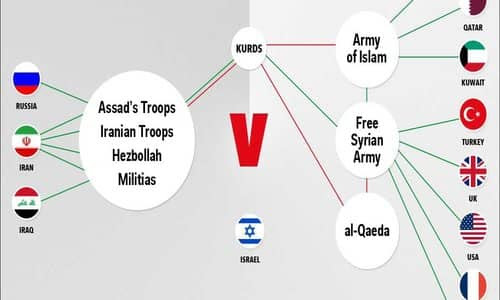
Who Is In Over Their Heads In Syria?

Agenda
 
Who's In Over Their Heads In Syria?
 
The key question about Syria this week is not why the various foreign powers involved in the civil war there are on the brink of hostilities. It's how hostile forces with very different agendas co-existing in a relatively small country have been able to avoid a violent confrontation up until now.
 
 
Hamas
 
Gaza March of Return Confirms Collapse Of Land-For-Peace
 
Hamas leaders Ismail Haniyeh and Yehya Sinwar have not hid the real goal behind the 'March of Return'--to destroy Israel."
 

Thursday, 12 April 2018

The Hamas Gimmick That Failed!

Return
 
The Hamas Gimmick That Failed
 
Hamas had announced that the families of those killed in the "return" campaign would receive the sum of $3,000, while anyone seriously injured would get $500, and anyone sustaining moderate injuries would be given $200.
 

Russia
 
Russia Can Stop U.S. Missiles, But It Won't Be Easy
 
Since the Cold War, Russia has been developing means to intercept U.S. cruise missiles and other advanced weapons. It may be about to put that to the test.
 

Will Israeli Air Force Buy More F-15s Or F-35s; Intel May Tip Balance

Israeli F-35A, known as the F-35I Adir
The Israeli Air Force (IAF) may delay the acquisition of a third Lockheed Martin F-35 squadron in favor of a fast purchase of additional new versions of the F-15.
In recent deliberations within the IAF’s high command, the leading direction was clear – -priority for the additional F-15’s while delaying the purchase of a third F-35 squadron.
However, the head of the IAF’s aircraft department, Col. H., told Breaking Defense that the force will soon face the decision whether to purchase additional F-35s, on top of the 50 that are included in the signed contracts. “We are very pleased with the performance of the aircraft,” he said.
Even before the delivery of the test aircraft the IAF has equipped the first F-35’s with Israeli-developed systems.
Sources told Breaking Defense that the rapidly changing situation in the Middle East, especially the Iranian effort to gain more influence in countries like Syria and Lebanon, makes buying F-35’s more urgent. The sources added that the decrease in the price of the F-35 will be a one of the main factors in the expected decision.
According to sources close to the issue, while the F-35 can perform best when its stealth feature is essential — in later phases of combat — the IAF believes the need is for other aircraft, ones with advanced avionics that can operate in conjunction with the F-35 and carry heavy loads of weapons.
Retired Brig. Gen. Assaf Agmon, who served in the IAF as a fighter pilot and in senior command position and then headed the Fisher Institute for Air and Space Strategic Studies told Breaking Defense that it will be a mistake to delay the acquisition of an additional F-35 squadron.”The F-35 is not just another aircraft, it brings a total revolution in the interoperability of air, ground and sea sensors  ”
He added that even the Americans have not yet learned the full operational capabilities of the F-35 “and what they do know they not always share with us. So we have to learn by ourselves and this is being done everyday”
He said that it will be a mistake to invest in another platform based on its capability to carry heavy loads of weapons systems: “The Israeli defense forces have enough ways to use massive fire power against faraway targets”.
Modified Israeli F-15Ds known as F-15 Baz
Another retired IAF brigadier general, who asked not to be identified, said that he was against the acquisition of the F-35 from the outset: “This is a very expensive aircraft that will not really change the capability of the IAF in the coming 20 years.” With the current Israeli defense budget there is no way to create a critical mass buying F-35s. “This is a niche system that cannot serve as a game changer. The combat now is based on standoff weapon systems, which makes the presence of an aircraft like the F-35 in the fighting area less important,” the retired general said.
The contrasting views of the two former high ranking IAF officers symbolize the debate within the IAF. The crucial factor may be the senior leadership of the Israeli Defense Forces and Israel’s intelligence community. The scales tip to the opposite direction whenever the intelligence guys present the most imminent threats, and these changes ARE frequent in the unstable Middle  East.
If the IAF decides to purchase additional F-15s, the deal is likely to occur in the middle of the 10 years U.S defense package that was recently approved by Washington. The new package, in effect from 2019, is for $38 billion over 10 years, up from the $31 billion over the last decade.
The IAF command wants to keep a “critical mass ” of fighter aircraft that can carry a variety of heavy load weapon systems, including some that are being currently developed by the Israeli defense industries .
The IAF’s F-15D  Baz are central to Israeli air power. They operate a number of missions including air superiority, strike, reconnaissance, and command and control and networking “stations”.
In the meantime, the IAF is continuing to open the envelope of F-35. And the IAF is adding capabilities to the already operational Adir stealth fighters. This even before the delivery of the dedicated test F-35 that will be delivered in 2019.
The Israeli F-35A, known as the F-35I Adir, recently took part in the attacks on Syrian ground-air systems that followed the downing of an Israeli F-16 by a Syrian ground -air SA-5 missile.
Maj. Gen. Amikam Norkin
The IAF refused to be specific but said that the stealth fighter’s capabilities are a “game changer.”
In mid-March, several IAF sources  described  the F-35 as a “super intelligence  collector” in stealth mode and with the capability to disperse the data to forces in the air and on the ground.
IAF Commander Maj. Gen. Amikam Norkin has decided to classify all F-35 operations so as not to give away data an enemy could use to decrease the stealth fighter’s capabilities.
The IAF’s Golden Eagle squadron is currently operating nine F-35 ‘s; this year another six will be delivered.

Israel Will Be Forced To Side With America Against Russia Should President Trump Launch Missiles On Syria!

New post on Now The End Begins

Israel Will Be Forced To Side With America Against Russia Should President Trump Launch Missiles On Syria

by Geoffrey Grider

israel-caught-middle-russia-america-syria

Israel’s skillful balancing act between superpowers is becoming too hard to sustain. Since U.S.-Russian relations started to fray following the 2014 annexation of Ukraine’s Crimea peninsula, with sanctions, diplomatic expulsions and consulate closures, Israel has worked hard not to become entangled in this confrontation.

"Then the king of Syria warred against Israel, and took counsel with his servants, saying, In such and such a place shall be my camp."2 Kings 6:8 (KJV)
EDITOR'S NOTE: If President Trump follows through on his threat to rain down missiles on Syria, America's biggest ally in the region Israel is going to be forced to side with them against Russia, and Russia will consequently retaliate against both the United States and Israel. Turkey, Iran and Lebanon would jump at the chance to side with Russia against their biggest enemy Israel, and in a matter of hours it could turn into a battle of Biblical proportions. And May 14th is officially now only a mere 34 days away...imagine that. 
It seemed to work until now. Prime Minister Benjamin Netanyahu maintained Israel’s strategic alliance with the U.S. while reaching crucial understandings with a resurgent Russia that has become a dominant force in his country’s backyard.
Russian President Vladimir Putin looked the other way as Israel repeatedly attacked Iranian and regime military installations in Syria. Russia also delivered on its tacit pledge to prevent the deployment of Iranian forces and their proxies in the vicinity of the Israeli-held Golan Heights.
In exchange, Israel took a much softer line on Russia than most Western countries. Those steps ranged from declining to support a U.S.-backed United Nations resolution on Crimea in 2014 to deciding not to expel Russian diplomats when over two dozen Western countries did so in response to the use of a nerve agent against a former Russian spy in the U.K. last month.
All of this is changing now that President Donald Trump (and, likely, France) is readying major strikes against the Syrian regime to punish it for its alleged use of lethal chemical weapons in the rebel-held Douma area northeast of Damascus. With Moscow warning of grave consequences if these strikes go ahead, Israel’s bilateral understandings with the Kremlin risk being swept away by a much broader clash.
“It has definitely been a goal of Israeli policy to avoid confronting Russia on a number of issues that have been a cause of friction between Russia and the West,” said Dan Shapiro, the U.S. ambassador to Israel in 2011-2017 and currently a fellow at the Institute for National Security Studies in Tel Aviv.
“But if we see an open conflict emerge between Russia and the U.S., I don’t think Israel could afford that luxury,” he added. “Israel’s primary alliance is of course with the United States. Israel will stand beside the United States, but this would be a particularly painful vise to be caught in.”
Despite those risks, Israeli officials support the idea of meaningful U.S. military action in Syria, in part because they want to enforce red lines against any use of chemical weapons in the Middle East—and in part because they think that such a campaign may prompt Mr. Trump to reconsider his announced desire to withdraw American forces that currently secure a large part of eastern Syria.
Such a withdrawal, in Israel’s view, would be a strategic boon to its existential foe, the Iranian regime, as well as to Russia.
“As long as the Americans are there, the Iranians are worried and restrained, and once the Americans will be out there will be a problem,” said Eyal Zisser, Syria expert at Tel Aviv University.

In a way, Israel’s current predicament with Moscow is a replay of the past. The Soviet Union helped establish Israel and was the first country to bestow on it de jure diplomatic recognition, as well as getting satellite Czechoslovakia to supply it with weapons in 1948.

But American-Soviet hostility during the Cold War pushed Moscow to sever its ties with Israel and to arm and fund Israel’s Arab enemies, most notably Syria.
It was only in 1991 that the two countries resumed diplomatic relations, an event followed by the migration of over a million Soviet Jews to Israel and the flourishing of business, tourism and cultural connections.
“The current friendly relations between Russia and Israel are a deviation from the norm,” said Maxim Suchkov, a Middle East expert at the Russian International Affairs Council, a state think tank. “The current escalation over Syria can shuffle all the cards, including the Russian-Israeli ties.”
Up until now, Mr. Netanyahu’s diplomacy resulted in Russia tolerating Israel’s military activity in Syria against Iran and Iranian proxies, within well-defined limits and using a coordination mechanism to prevent mishaps.
“There are a lot of agreements and understandings. As long as Russia has no Russians hurt in Israeli actions and Israel doesn’t threaten the stability of the Assad regime, tactical deconfliction and leadership interactions make it easier,” said reserve Brig. Gen. Assaf Orion, who served until 2015 as head of strategic planning in Israel’s General Staff.
That equation, however, would change fundamentally should U.S. (and French) military action pose a material threat to the Syrian regime’s stability—and endanger Moscow’s hard-won sway in Syria.
“Netanyahu’s many visits to Moscow were great, and I am sure that his personal relations with Putin are very warm and close,” said Ksenia Svetlova, a Russian-born Israeli lawmaker. “But that doesn’t change the fact that Russia has its own ironclad interests in Syria, and that those interests are incompatible with ours.” source